Benefits of a virtual assistant for customer service
Discover the benefits of a virtual assistant for customer service, how to implement the technology, and how to choose a suitable solution for your company.

Listen to the article
Understanding the benefits of a virtual assistant helps small and medium-sized businesses serve better without turning every question into a manual task for the team.
Quick response
The main benefits of a virtual assistant in customer service are reducing repetitive tasks, responding quickly, operating continuously, and better organizing customer triage. The technology uses artificial intelligence and natural language processing to understand requests, consult information, and, when integrated with the right systems, execute actions. For a small or medium-sized business, the best approach is to start with frequently asked questions, define when the service should escalate to a person, and monitor indicators such as response time, resolution, and satisfaction. This way, the assistant complements the team without replacing the human touch in complex cases.
Summary
- A virtual assistant uses artificial intelligence and natural language processing to converse and automate tasks.
- The technology reduces the burden of initial customer service, improves response speed, and keeps the channel available continuously.
- Implementation should start with clear objectives, reliable content, proper integration, and transfer to human agents.
- Virtual assistants are broader than chatbots based solely on fixed flows, as they can understand context and perform actions.
- The outcome depends on constant review, data protection, and a consistent experience across the website, WhatsApp, and other channels.
What is a virtual assistant?
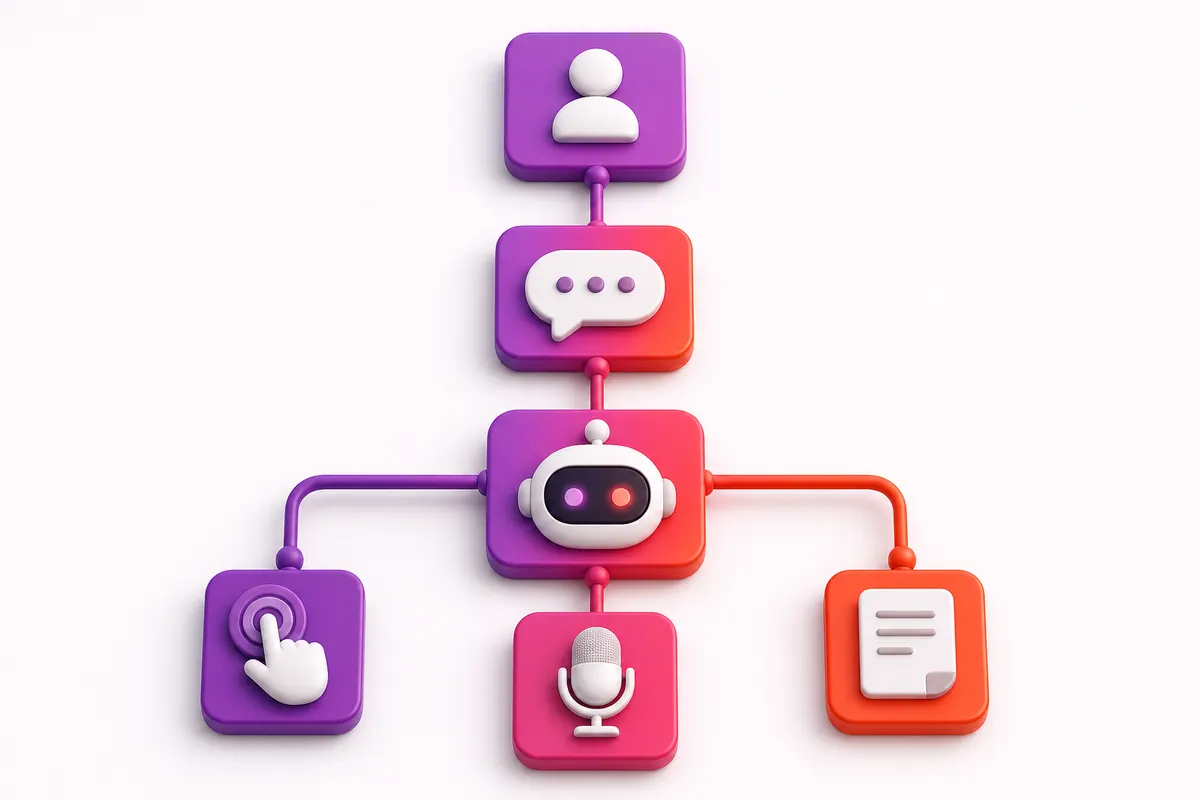
A virtual assistant is software that uses artificial intelligence to converse with people via text or voice, interpret requests, and provide answers or referrals. In business customer service, it handles frequently asked questions, collects information, and can perform tasks connected to the company's systems.
Unlike a static FAQ page, the virtual assistant interacts in natural language. It can understand a question written in different ways, identify the visitor's intent, and guide the conversation towards a helpful direction. According to Santo Digital, these systems are powered by artificial intelligence and machine learning and can interact through voice or text commands.
Natural language processing, known as NLP, allows for interpreting the meaning of the message rather than relying solely on exact words. This is important for Brazilian businesses because customers write with abbreviations, regional variations, typos, and incomplete questions.
In practice, a store can use the assistant to provide information on hours, location, payment methods, service availability, or delivery conditions. A clinic can organize initial requests, while a service company can capture the subject of the contact and forward it to WhatsApp. The role of technology is to make the first contact more accessible and organized, without eliminating the need for human assistance in sensitive situations.

How does a virtual assistant work?
The operation combines understanding the message, consulting information, defining the response, and, when permitted, executing an action. The customer converses in a digital channel, and the assistant interprets the request to decide whether to respond, collect data, trigger an integration, or transfer the case.
First, the system receives the message via text or voice and identifies the intent. Next, it compares the request with the company's knowledge base, which should contain up-to-date information about products, services, hours, policies, and contact methods. The clearer and better organized this base is, the lower the chance of a vague response.
After interpretation, the assistant formulates an appropriate response to the context. In a well-configured conversation, it does not repeat generic information when it already knows the visitor wants to schedule, request a quote, or resolve an issue. If there is integration, it can also record data, forward a request, send a proposal, or direct the conversation to a human channel.
Automation needs to have defined limits. When the message involves a delicate complaint, negotiation outside the rules, excessive personal data, or a question that the system cannot support, the best decision is to explain the transfer and provide the history to the agent. IBM describes virtual agents as systems that identify intent and automate steps to meet it while continuously improving this capability.
For a small business, the flow can start simply: introducing the business, answering recurring questions, capturing the visitor's name and subject, and sending the contact to WhatsApp. NaInter.net recommends thinking of the smart website as a gateway to information and conversations, with the assistant helping the customer find the next step without relying on someone being available at all times.

What are the benefits of a virtual assistant?
The most relevant benefits are economic and operational: less repetitive work, faster responses, continuous service, and better utilization of the team. The gain appears when automation resolves what is predictable and forwards what requires human judgment.
Reduction of operational costs
A considerable part of customer service consumes time with repetitive questions: hours, address, payment methods, availability, status of a request, and initial guidance. By taking on this volume, the assistant reduces the need for manual intervention in each conversation. Santo Digital states that implementation significantly reduces monthly costs and frees the team for more important activities.
This does not simply mean removing people from the process. For small and medium businesses, the value lies in enabling the same team to serve better, without interrupting sales, production, or management for every basic question. The entrepreneur can focus the team on negotiations, exceptional cases, relationships, and decisions that require contextual knowledge.
Economies of scale also come into play. ManageEngine reports that virtual assistants can serve multiple users simultaneously and in real-time. During a campaign, on a high-demand day, or after a social media post, this capability prevents the first contact from getting stuck in a manual queue.
Control improves when the company precisely defines what data the assistant can collect and what responses it can provide. This reduces rework, avoids incomplete requests, and facilitates the forwarding of more qualified leads to the sales team.
Increased efficiency in customer service
Efficiency is not just about responding in any way. It’s about delivering the right information, through the appropriate channel, with minimal friction. The assistant can organize the conversation, ask screening questions, and record context before transferring the customer. This way, the human agent does not have to start from scratch.
Santo Digital reports that service times are reduced when the company better controls the information collected by the assistant. In a local business, this can mean asking for the type of service, the service area, and preferred timing before forwarding a quote.
Technology also aids in prospect acquisition. According to Santo Digital, virtual assistants can qualify contacts and scale acquisition while maintaining service quality. However, quality depends on well-defined criteria: an objective question should lead to a clear next action, not a tedious sequence of messages.
There is also an effect on consistency. The response does not change because a person is busy, because traffic has increased, or because the contact occurred outside of office hours. The business presents its essential information in a standardized manner while preserving the possibility of personalized service when the situation demands it.
Availability 24/7
Many customers research and send messages outside of business hours, including at night, on weekends, and holidays. ManageEngine reports that virtual assistants operate twenty-four hours a day, ensuring service during these periods. This does not mean that all problems will be resolved immediately, but the visitor receives guidance, can initiate a request, and knows how to proceed.
Continuous availability is especially useful for businesses with a website, menu, service catalog, or schedule. The assistant can present basic information, capture the conversation, and send the contact to the company's WhatsApp, allowing the team to pick up the case when they are available.
This benefit needs to be communicated honestly. The system should inform when it is providing an automated response and clarify which situations will be handled by a person. A well-managed expectation is often more valuable than promising an instant solution for any demand.
Forrester reports that seventy-one percent of buyers want an experience tailored to their needs and preferences, and seventy-four percent desire an immediate response. These percentages help understand why speed and personalization need to go hand in hand: responding quickly without considering the request does not create a good experience.
Have a professional website working for you 24/7
Let the Artificial Intelligence of NaInter.net create the perfect showcase for your business to attract customers every day.

How to implement a virtual assistant in your business?
Implementation should start with a well-defined customer service problem, move on to choosing the solution, and end with testing, monitoring, and continuous improvement. It is not necessary to automate the entire journey at once.
Choosing a virtual assistant for businesses
Start by mapping the questions that occupy the team the most and the moments when customers abandon contact. Then, choose a solution that understands natural language, allows for organizing a knowledge base, and offers integration with the channels used by the business. For many Brazilian companies, a website and WhatsApp are natural starting points.
Also consider the ability to transfer to a person, the recording of conversations, the ease of updating, and privacy controls. The solution must allow the company to correct information without relying on a complicated process. It should also separate what the assistant can answer from what requires human approval.
Google Cloud states that virtual agents can be specifically trained to interact with customers in call centers. This specialization is important: an assistant trained for a real estate agency should not converse like one from a restaurant or a maintenance company. The vocabulary, questions, and referrals need to reflect the actual business.
NaInter.net offers intelligent websites with an AI virtual assistant, menu hosting, service promotion, hours, location, photos, social media links, and delivery, as well as chat capture and direct sending to the company's WhatsApp. To decide, evaluate whether this set corresponds to the journey you intend to improve, without hiring functions that will not be used.
Training and personalization of the assistant
Gather official responses before opening customer service. Include company introduction, services, hours, service areas, contact methods, frequently asked questions, and criteria for referrals. Write in the way the audience speaks, but maintain objective instructions to reduce ambiguities.
Next, create examples of real conversations, including incomplete questions, messages with errors, and situations where the customer changes the subject. Test whether the assistant understands the intent, asks only what is necessary, and avoids making up information. When it does not know the answer, it should admit its limits and offer a useful alternative.
Personalization includes tone of voice, vocabulary, and security rules. It also involves periodically reviewing the knowledge base, especially when there are changes in price, hours, menu, return policy, or service area. In compliance with LGPD, collect only the data necessary for the stated purpose and maintain a pathway for requests related to personal data.
Training does not end at launch. Analyze unanswered conversations, frequent transfers, and confusing questions. Turn these findings into improvements in the knowledge base and workflow. The goal is to build a service that becomes clearer with use, not a system abandoned after the initial setup.
- Map repetitive questions and points of friction in customer service.
- Choose a solution with natural language processing, integrations, history, and human transfer.
- Organize the knowledge base with official and updated information.
- Set limits, tone of voice, data collection, and routing rules.
- Test real conversations before publishing the assistant on the main channel.
- Monitor interactions and periodically review responses, flows, and content.

Is it worth becoming a virtual assistant?
For most companies that receive repetitive questions or contacts outside of business hours, it is worth adopting a virtual assistant to support the team. The decision is safer when the goal is specific, data is organized, and there is a clear path for human assistance.
For small entrepreneurs, the return tends to be more noticeable when the team spends time on predictable requests. A salon can guide about services and schedules; a store can present the catalog and capture purchase intent; a service provider can filter by region, type of demand, and the best contact channel.
It is not the best choice when the company has not yet defined its basic information, frequently changes rules without updating the team, or expects automation to resolve complex conflicts on its own. In these cases, the first investment should be in structuring processes and responses.
The central criterion is the balance between volume, complexity, and desired experience. If automation shortens the path to the solution and preserves human involvement when necessary, it ceases to be just a technological novelty and starts functioning as a service infrastructure.

What are the differences between virtual assistants and chatbots?
Chatbots typically follow pre-configured flows and decision trees, while virtual assistants use artificial intelligence and natural language processing to understand a wider variety of requests and perform tasks connected to systems.
The difference is not absolute, as the terms are sometimes used synonymously. Still, the traditional chatbot usually guides the user through predefined options: choosing a menu, selecting a category, and receiving a prepared response. This model can be efficient for simple and highly controlled journeys.
The virtual assistant operates in a more dynamic way. As explained by ManageEngine, it goes beyond the traditional chatbot by understanding natural language and connecting to systems to perform more advanced actions. Instead of just displaying information, it can collect data, organize a request, or forward the conversation with context.
SAP highlights that digital assistants tend to handle a wider variety of tasks, maintain more continuous and contextual conversations, and integrate with more devices and services. IBM, in turn, defines a chatbot as a broad term for programs that simulate human conversation in real-time, while virtual assistants execute commands and tasks for the user.
To choose between a simple or broader experience, consider the objective. If the customer only needs to select a fixed option, a structured flow may suffice. If they describe the problem freely, expect personalized guidance, or need to initiate an action, look for a solution with context understanding, integrations, and escalation to people.

The future of virtual assistants in customer service.
The future of virtual assistants in customer service will be marked by more contextual conversations, integration with processes, and closer collaboration between artificial intelligence and human teams. The differentiator will not just be responding, but understanding the customer's moment and acting within reliable limits.
The trend is for the assistant to stop being an isolated window and become part of the operation. It will be able to consult authorized information, summarize history, suggest the next step, and provide the agent with a more complete view of the case. For the customer, this reduces repetition; for the team, it improves continuity.
Automation should also reach areas beyond initial support. Santo Digital describes uses in scheduling, onboarding, and training new employees, with responses about policies and procedures. In small companies, this can help organize internal routines without creating more interruptions for those managing the business.
Another path is the multichannel and multilingual experience. Santo Digital points out that virtual assistants operate in interactions across different channels and languages. In Brazil, the priority is often to maintain consistency between the website, WhatsApp, and social media, using simple language and respecting the characteristics of each channel's audience.
Technological advancement does not eliminate responsibilities. The company will still need to review responses, control permissions, protect data, and explain when the customer is talking to automation. The LGPD should guide the collection and use of information, and human transfer should remain accessible.
To take the next step, choose a single journey, such as questions about services or budget requests. Organize the content, publish the assistant on a relevant channel, and monitor the conversations. From there, expand only what demonstrates utility. This approach reduces risks and transforms the benefits of the virtual assistant into observable improvements in service.
- Define an initial service journey to automate.
- Review the knowledge base and access permissions.
- Integrate the assistant into the channel used by your customers.
- Inform about the limits of automation and ensure human transfer.
- Measure the quality of responses and expand uses based on conversations.
- Reduce repetitive questions on WhatsApp and the website. → Start with a frequently asked questions base and set up forwarding to the team.
- Serve customers outside of business hours. → Use an assistant with continuous availability, transparent messaging, and contact logging.
- Capture more budget requests. → Set up screening questions and send the summary to the appropriate sales channel.
- Avoid inconsistent responses. → Centralize official information and review the base whenever a business rule changes.
- Automate a complex journey. → Choose a solution with context understanding, integrations, and human transfer.
Continue reading

How automation can save time in customer service

How an intelligent virtual assistant can transform your business