How to implement 24/7 customer service in small businesses
Understand how to structure 24-hour support for small businesses, choose channels, train the team, and enhance the customer experience.

Listen to the article
Serving customers outside of business hours is no longer exclusive to large operations. For small businesses, the combination of automation, digital channels, and human forwarding can increase availability without disrupting routine.
Quick response
24/7 support for small businesses is an operation that keeps a channel available at all times, using automation for recurring questions and people for situations that require analysis. The most efficient approach is not to keep all channels on permanent standby, but to set priorities, organize a response database, establish when to transfer conversations, and monitor results. A website with a virtual assistant, chat, social media, and telephony can create a seamless journey, as long as each resource has a clear function and respects data privacy.
Summary
- Continuous availability does not mean that a person needs to respond to everything during the night.
- Automation works best for recurring information, triage, data collection, and forwarding.
- The company needs to define scope, language, transfer to humans, and handling of urgent situations.
- Chat, social media, and phone can work together when there is a history, responsible parties, and indicators.
- Customer service should be reviewed based on actual customer questions, not just on the chosen technology.

What is 24-hour service for small businesses?
It is a support, information, and relationship structure that allows customers to get guidance outside of business hours, through automation, self-service, or human support. For a small business, the most sustainable model combines a virtual assistant with contact channels and a clear forwarding process.
The concept of 24-hour service for small businesses does not require the owner to stay connected all night. It means that the customer finds a functional entry point when they decide to research a service, consult a menu, check a purchase condition, request a location, or submit a request. The response can be immediate and automated, while cases that require judgment are organized for the team to take over at the appropriate time.
In practice, there are different layers of availability. The first provides basic information, such as services, hours, location, contact methods, and frequently asked questions. The second collects context, identifies the visitor's intent, and records a request. The third involves a person, either on duty or in the next work period. Mixing these layers without explaining what happens often leads to frustration because the customer interprets an automatic message as a promise of immediate human service.
Automation should also not be treated as a generic conversation that answers any topic. It needs to start from information approved by the company, recognize when it is unsure how to respond, and forward the case. A neighborhood store, a salon, a clinic, a restaurant, and a service provider have different recurring questions. The content of the service needs to reflect the vocabulary, limits, and operational style of each business.
NaInter.net understands continuous service as part of a smart website: the business can present a menu, services, hours, location, photos, social media links, and deliveries, while the virtual assistant responds instantly, captures the conversation, and can forward the contact to the company's WhatsApp. The value lies in bringing information and the next action together in the same journey, without turning the digital presence into a response-less showcase.
According to Kaseya, a 24-hour Help Desk allows customers or users to reach out at any time. For a smaller company, this availability can be applied proportionally: the channel remains open, simple inquiries receive guidance, and requests that need a person are recorded with enough context to prevent the customer from having to repeat everything.

Why offer 24-hour service?
Providing service outside of business hours can reduce the gap between the moment a need arises and when the customer can act. A person might discover a service at night, compare options over the weekend, or need information while the team is busy with operations. If they find no guidance, the conversation may die before turning into a quote request, reservation, or purchase.
The first advantage is convenience. The customer does not need to adapt their entire routine to the company's hours to obtain basic information. This is especially relevant for businesses serving freelancers, families, consumers working shifts, or people researching after their daily activities. Availability does not guarantee conversion, but it removes a concrete barrier from the path.
The second is speed in triage. A well-configured system separates a question about an address from a request that needs evaluation, identifies the subject, and collects useful data. The team starts the next period with a more organized queue, instead of sifting through loose messages across different channels. This operational gain can be more important than simply responding quickly.
The third is consistency. A knowledge base prevents each employee from describing a service differently or forgetting relevant information. Hours, internal policies, service areas, and contact methods are presented uniformly. When something changes, the company updates the main source and reduces the chance of keeping outdated responses scattered across the internet.
There is also an effect on the perception of professionalism. A channel that explains what it can do, what it cannot do, and when a person will return conveys organization. The opposite is also true: promising human presence and delivering only vague responses undermines trust. Therefore, communication should be transparent from the first message.
Continuous service can also support consultative sales. Instead of pushing an offer, the assistant can clarify differences between services, present information published by the company, ask qualifying questions, and direct the visitor to a conversation. The contact reaches the team with a clearer intent, which saves time and improves the quality of the approach.
There are signs that this application is already reaching smaller businesses. WhatsApp Business launched Business AI for SMEs, allowing for automatic service outside of business hours. The tool has been described as capable of responding to customers 24 hours a day, 7 days a week. This data does not eliminate the need for planning: available technology does not replace correct content, supervision, and a route for exceptional cases.
In another move, it was reported that Claro uses AI to help SMEs sell via WhatsApp with both human and automated support, describing the virtual assistant as available 24 hours a day. For the small business, the lesson is not to copy a large operation but to observe the division of roles: automation for scale and team for context, negotiation, sensitivity, and decision-making.
Have a professional website working for you 24/7
Let the Artificial Intelligence of NaInter.net create the perfect showcase for your business to attract customers every day.

What are the main challenges of 24/7 customer service?
The first challenge is financial and operational. Continuous service seems simple when the conversation is automated, but it requires updated content, monitoring, integration between channels, and someone responsible for cases that deviate from the script. If the company creates a channel without defining who handles the requests, it accumulates messages and turns the promise of availability into an invisible queue.
Another point is the quality of responses. An assistant who is unfamiliar with the catalog, confuses schedules, or invents a commercial condition can cause greater harm than silence. The knowledge base should be written in clear language, revised when changes occur, and limited to what the company can truly fulfill. Reliable responses should also acknowledge a lack of information and guide the next steps.
Transferring to a person is a delicate step. The customer should know when they are speaking with automation and what will happen next. In sensitive matters such as complaints, cancellations, payments, personal data, or requests outside of policy, the system needs to minimize improvisation and direct the issue to a responsible party. A well-directed conversation preserves the history, the reason for contact, and the information already provided.
Privacy deserves special attention. Capturing name, phone number, order, or description of a problem can be useful, but the company should only collect what is necessary, inform the purpose, and control who accesses these records. The LGPD applies to the handling of personal data, including in digital channels. NaInter.net informs that the registration data of companies and visitors are used for the operation of microsites, email redirection, payment processing, and operation of virtual attendants, and that they are not sold to third parties.
There is also the challenge of technical availability. Unstable internet, interrupted integration, or incomplete configuration affects the experience precisely when no one is in the office to notice. Therefore, the operation needs alerts, tests, and an alternative contact method. The plan should not only consider the ideal scenario but also the temporary unavailability of a channel.
Language is another risk. Excessively formal messages, long responses, or confusing menus can cause the customer to abandon the conversation. The service of a small business can be professional without seeming distant. The ideal is to use direct sentences, explain the next step, and maintain a tone consistent with the brand.
Finally, there is the challenge of measuring value. The number of messages does not reveal whether the service helped. It is necessary to observe unanswered questions, transfers, time until human response, complete incoming contacts, and reasons for dissatisfaction. The analysis should lead to concrete adjustments in the knowledge base and workflow, not just a monthly report.
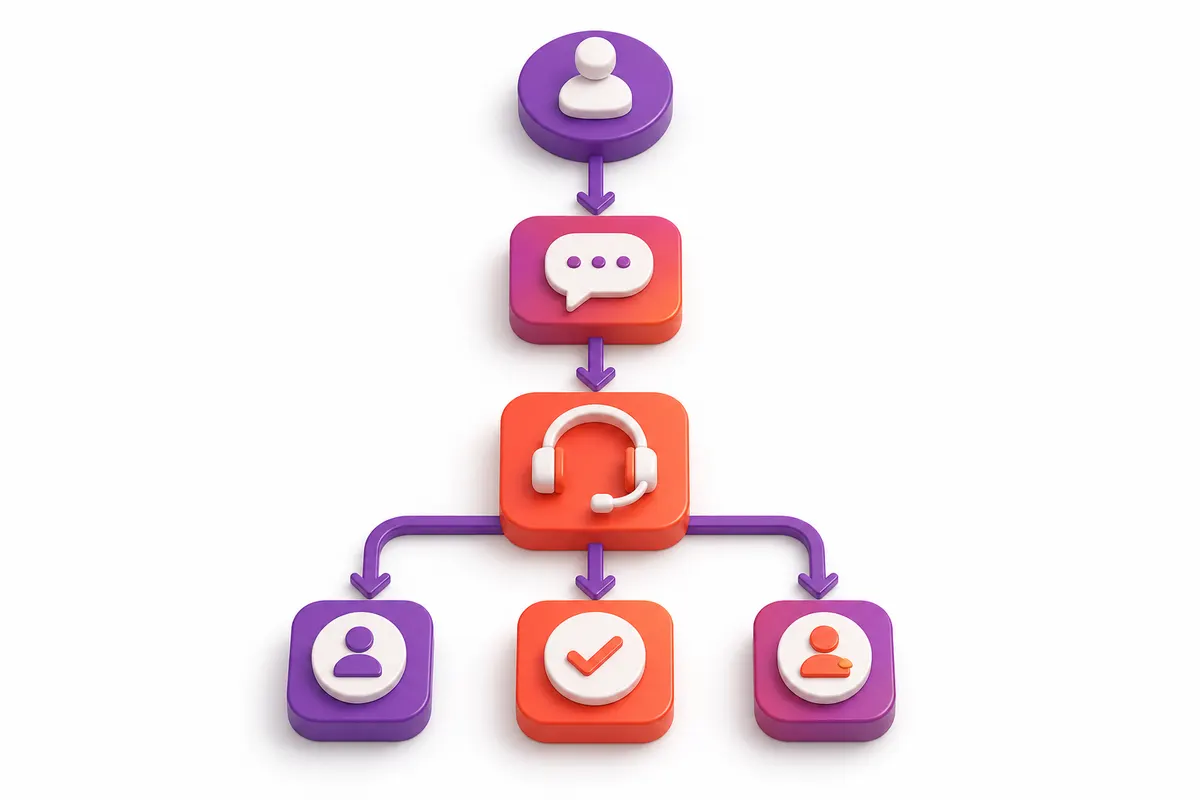
How to implement 24/7 service in your company?
Start with the questions customers ask most and design a journey that combines automated information, context gathering, and human escalation. Then, select channels compatible with your routine, train those who handle exceptions, and monitor indicators that show whether the service truly resolves demands.
Defining the service strategy
The strategy should arise from the business needs, not from enthusiasm for a tool. Observe received messages, questions at the counter, recurring calls, and inquiries made on social media. Group these topics by intent: information, budget, scheduling, order, support, complaint, or urgency. This analysis shows what can be answered automatically and what needs a person from the start.
Next, establish the scope of availability. A company can keep information open at any time and offer continuous triage but leave complex negotiations for business hours. Another may create on-call support for critical situations. The important thing is to write the rule in an understandable way, including the time for human response when necessary. Customers accept an explained wait much more easily than an ambiguous expectation.
Create a short journey. The initial message should indicate that the visitor is speaking with an assistant, present topic options, and offer an exit to speak with the team. Then, ask only for the necessary data to proceed. At the end, confirm what has been recorded and what the next step will be. This sequence reduces abandonment and facilitates continuity between automation and human service.
Also define priority criteria. A question about location can be resolved by published content. However, a failure in an order, a payment issue, or a situation involving personal data should follow a controlled route. The company needs to decide who receives each type of request and how the history will be consulted.
Treat the website as a reference point for digital operations. When services, hours, location, photos, and contact methods are gathered, the assistant works with a more consistent source, and the customer finds information before starting a long conversation.
Choosing the right technology
Choose technology based on the channels your customers already use and your team's capabilities. A website with chat can concentrate information and capture contacts; social media can receive questions and direct them to an organized journey; telephony can serve those who prefer voice or need to explain a situation in more detail. It is not necessary to activate everything at once.
The central requirement is the continuity of context. If the visitor starts on the website and ends up on the company's WhatsApp, the history or at least a summary of the request should accompany the transition. Without this, the person repeats data, the team wastes time, and the experience feels fragmented. Integrations should be evaluated by this criterion, not just by the number of advertised features.
For automation, seek control over the response base, routing rules, permissions, and records. The technology should allow correcting information without rebuilding the entire operation. It should also make it clear when the system does not know how to respond. A reliable assistant does not try to appear knowledgeable about everything.
Security needs to be part of the choice from the beginning. Check how data is stored, who can access it, what information is truly necessary, and how the company handles requests related to the LGPD. NaInter.net itself states that its platform is operated by Wave Core IA & Hardware Sync and that data is not sold to third parties, within the purposes stated in its terms of use and privacy.
Before expanding usage, conduct tests with real questions and variations in language. Customers do not always write with the exact phrase expected in the script. Evaluate abbreviations, typos, incomplete messages, and requests that mix topics. Implementation should occur with progressive adjustments, maintaining a simple alternative for those who do not want to engage with automation.
Training the team for service
Training is not just about teaching how to operate a screen. The team needs to understand the promise made to the customer, the limits of the assistant, the priority criteria, and the company's tone of voice. Those who take over a transferred conversation should be able to see the reason for contact, recognize what has already been answered, and avoid repeated questions.
Create guidelines for frequent situations. A good guideline explains what to confirm, what information can be shared, when to ask for support, and how to record the conclusion. In complaints, the initial focus should be on understanding the problem and informing the next step, not disputing the narrative with the customer. In sales, the attendant should ask useful questions without being pushy.
Also train the communication of unavailability. If a system fails, the team needs to know which alternative channel to use and how to inform the public. If the timeline for human response changes, the message should be updated quickly. Trust is maintained when the company acknowledges the limitation and offers concrete guidance.
The practice can use anonymized real conversations and test scenarios. Include objective requests, emotional messages, out-of-scope questions, and requests with sensitive data. Then, review whether the agent responded clearly, protected privacy, and guided the customer to a resolution.
Training should continue after the launch. Questions that the assistant did not understand are material for improving the knowledge base. Answers that generate new doubts indicate that the content needs to be rewritten. This way, the team participates in the evolution of automation, rather than viewing it as a closed box.
Monitoring and evaluating customer service
Track indicators that connect service and results. Observe the most sought-after topics, the proportion of conversations forwarded, unanswered questions, the time until human response, and the number of contacts that come with sufficient data for the team to act. The goal is not to reduce all transfers, as some cases genuinely need human intervention.
Read conversation samples frequently. Numbers show where there is friction, but text reveals why it happens. A sequence of messages may indicate that the menu is confusing, that the customer did not understand a policy, or that the assistant is asking for too much information. Qualitative review transforms statistics into decisions.
Create a cycle of improvement. First, identify a recurring question. Then, confirm the correct answer with the responsible area, publish a clear version, and test with variations. Next, observe if the doubt has decreased. This process avoids changes based on assumptions and keeps the information aligned with operations.
Also evaluate the experience by channel. A good chat does not compensate for a call that drops constantly, just as a busy social media presence does not resolve a request that lacks a responsible party. The view should encompass the entire journey, from discovery to resolution.
Use alerts for occurrences that cannot wait, but avoid turning every message into an urgency. Priority needs to have an objective definition. With governance, continuous availability stops being just a promise of presence and becomes an operation that learns from actual customer behavior.

What tools can help with 24-hour service?
The most useful tools are those that combine availability, clarity, and context transfer. For most small businesses, chat on the website, organized service on social media, and phone systems with proper forwarding form a sufficient base to start.
Online chat systems
Online chat is suitable for answering questions while the visitor navigates the website. It can present services, hours, location, menu, ordering methods, and frequently asked questions without requiring the person to search for each piece of information on a different page. When connected to a virtual assistant, it can also identify intent, capture contact, and forward the conversation to the team.
The best chat is not the one that initiates a conversation at any cost. It is the one that appears at the right moment, offers a simple question, and allows the visitor to proceed without getting stuck in a menu. The message should explain the assistant's function and indicate how to talk to a person. If the company is not providing human support at that moment, this condition needs to be visible.
For small businesses, an intelligent website can serve as an information hub and contact entry point. NaInter.net offers professional website creation with artificial intelligence, with the possibility of hosting business information and providing a 24-hour AI assistant. Proper use depends on keeping the content updated and defining which requests will be sent to the company's WhatsApp.
Chat can also support the accessibility of operations. People who cannot call or prefer to write find an alternative. Still, the channel should avoid asking for excessive information and needs to offer a way to correct when the assistant misinterprets the message.
Test the chat on mobile, as a large part of interactions occurs on small screens. Check if reading is comfortable, if the buttons are understandable, and if forwarding works. A technically advanced feature loses value when it takes too long to load or interrupts the conversation.
Customer service via social media
Social media brings the company closer to people who are already discovering products, services, and local references. Comments, private messages, and responses to posts can generate opportunities, but they also spread service across difficult-to-control environments. The strategy should define which topics will be resolved there and which will go to a central channel.
A public response can clarify a common doubt, while personal issues should migrate to a private conversation or the website. The team needs to be careful not to request sensitive data in open comments. It should also log the request when it requires follow-up, rather than relying solely on the memory of the person who responded.
Customer service on social media can operate 24 hours a day to ensure inquiries are not left unanswered. For small businesses, this may mean maintaining an automatic response or guidance outside of business hours, without promising that there will be a staff member negotiating or resolving all cases during the night.
Consistency between social media and the website is essential. If the hours or service description diverge, the customer does not know which information to consider. Centralizing the response base and reviewing profiles reduces this risk. When the topic is longer, forward it to a channel that preserves context and allows for follow-up.
Monitor mentions and repeated questions. They show what the audience did not find on the page, what is causing confusion, or which service generates the most interest. This learning should feed back into the website, chat, and team training.
Telephony solutions
Telephony remains important when the customer needs to explain a situation, negotiate details, or speak with someone who does not feel comfortable using chat. A continuous service solution can use voice menus, informative messages, queues, request recordings, and transfers to a team or on-call staff. The design should be simple, as extensive menus increase abandonment.
Claro states in its code of practices that its telephone service channels operate 24 hours a day, 7 days a week, except for the Ombudsman. On the other hand, Doctor SAC offers a 24x7 call center for businesses, including nights, weekends, and holidays. These examples show that voice continuity can be structured, but a small business should scale the service according to the volume and complexity of calls.
To start, define which calls require immediate attention and which can generate a protocol or request for a callback. Record objective messages, provide accurate timings, and avoid making the customer repeat their story when switching channels. If the call is recorded, explain the purpose of the collection and limit access to responsible individuals.
Telephony can complement the website and chat, not compete with them. Simple information can be available online, while the phone handles cases that require listening and decision-making. This division reduces pressure on the team and offers choice to the customer.
Finally, evaluate missed calls, reasons for contact, wait times, and transfers. A 24-hour open line is not enough if no one can complete the request. Technology needs to be linked to a process, a responsibility, and constant review.
- Answer recurring questions without keeping a person connected during the night. → Create a knowledge base and use a virtual assistant on the website, with a transparent message about when the team takes over.
- Capture budget requests outside of business hours. → Use chat to understand intent, record necessary data, and forward an organized summary to the team.
- Serve customers who prefer social media. → Set up automatic responses, avoid collecting sensitive data in public, and direct complex cases to a channel with history.
- Provide voice support in more delicate situations. → Structure a telephony solution with a short menu, priority criteria, and an alternative for calls outside of human shifts.
- Avoid letting automation undermine trust. → Limit responses to validated content, inform when automation is in use, and facilitate transfer to a person.
- A company that receives many questions about services, hours, or location.: Start with an organized website and a virtual assistant based on approved content.
- A business that primarily receives contacts through social media.: Use social networks as an entry point, but create a route to record and track requests outside of comments.
- An operation with complaints, requests, or situations that require detailed explanation.: Combine automation for triage with telephony or trained human support for resolution.
- A company that does not yet know the volume or main reasons for contact.: Map current questions, choose an initial channel, and measure service before expanding the structure.
Continue reading

Human or Virtual Support: Which is the Best Option for Your Business?

Challenges of 24/7 customer service and how to overcome them